

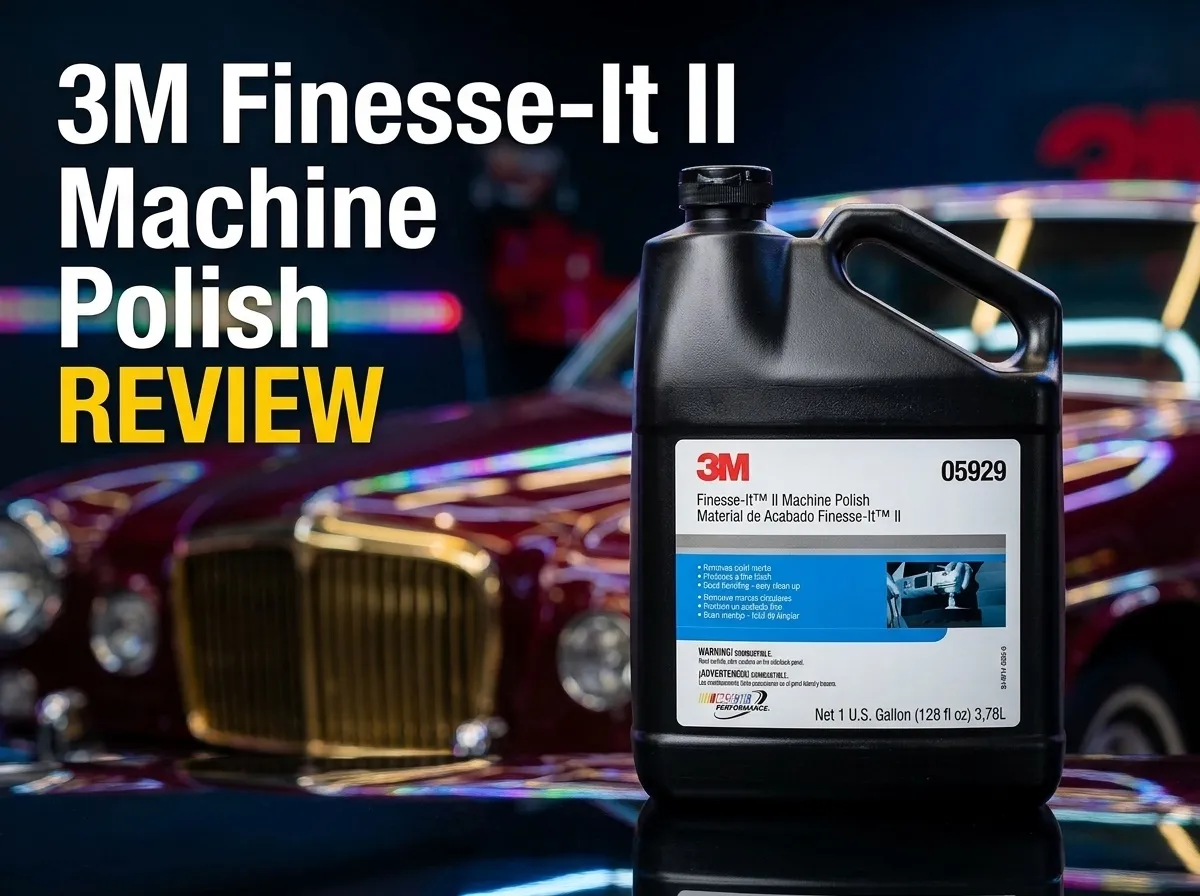
3M Finesse-It II Machine Polish Review — Still Worth It?
Meta Description: Read our hands-on 3M Finesse-It II Machine Polish review. Discover if this classic, filler-free automotive and marine polish is worth your money.
I recently took on a project that every detailer dreads: a black 2014 sedan that had spent its entire life going through cheap automatic car washes. The paint was a spiderweb of deep compounding swirls, microfine scratches, and light oxidation. It looked dull, gray, and completely stripped of life.
I needed a finishing polish that would permanently level the clear coat rather than just fill the scratches with temporary oils. I grabbed a bottle of 3M Finesse-It II Machine Polish (05929). I wanted to see if this industrial-grade formula still sets the benchmark for a true mirror finish, or if modern consumer alternatives have left it behind.
## Quick Verdict — Is 3M Finesse-It II Worth Your Money? ### Our Rating & One-Line Summary Score: 9.2 / 10
An exceptional, filler-free professional polish that permanently removes fine swirls and delivers a deep, wet-look shine on paint, fiberglass, and plastics. ### What We Loved
- True Paint Correction: Because it contains zero silicones or fillers, it completely eliminates micro-scratches rather than temporarily hiding them.
- Zero-Dust Workability: The aluminum oxide abrasive formula stays wet and active for a long time, meaning it does not create a cloud of white powder.
- Incredible Surface Versatility: It performs equally well on automotive clear coats, oxidized RV fiberglass panels, marine gelcoats, and plastic headlight lenses.
- High Initial Price Point: Buying the full 1-gallon industrial jug requires a significant upfront financial commitment.
- Zero Surface Protection: It provides no lasting barrier against the elements, making an immediate follow-up wax or ceramic coating mandatory.
- Poor Manual Performance: If you attempt to use this product by hand without a machine buffer, it requires an exhausting amount of physical labor.
## Paint Correction and Clarity — The Core Performance The main reason anyone buys this product is to achieve absolute clarity on a painted surface. It is engineered as an ultra-fine finishing polish utilizing a grit number of 128. This means it is designed to step in after heavy compounding or fine-grade 3000-grit wet sanding to erase the microscopic haze left behind. ### Eliminating Clear Coat Swirl Marks To test the core capabilities, I sectioned off the hood of the black sedan into two distinct test panels using masking tape. #### Real-World Test: On a Severely Swirled Black Hood I applied three pea-sized drops of the polish onto a pad and set my machine to a medium speed. Using light to medium downward pressure, I moved the tool in a slow cross-hatch pattern across the first section. The polish spread smoothly and clear. It allowed me to see the paint defects as I worked. After four passes, the microfine compounding swirls were completely gone. The paint transitioned from a hazy gray to a rich, deep, jet black. When I wiped the residue away, I was left with a flawless, mirror-like finish that showed no signs of hologramming. ### Restoring Single-Stage Paints Single-stage paints are notoriously finicky because they are softer and transfer pigment directly onto your working pad. On an older truck with oxidized single-stage red paint, the aluminum oxide abrasives leveled the chalky top layer safely. It did not heat up the panel excessively or gum up the face of the buffing pad. It brought back the original vibrant red hue in a single detailing cycle.
## Marine and RV Gelcoat Restoration Fiberglass and marine gelcoats are much harder and more porous than standard automotive clear coats. They require an abrasive that can cut through heavy chalky oxidation without scouring the surface. ### Reviving a Weathered Boat Hull Gelcoats face constant abuse from UV rays and saltwater, which leaves them looking dull and white. #### Real-World Test: On an Oxidized Fiberglass Boat Hull I tested the product on a 20-year-old boat hull that had completely lost its gloss. I paired the polish with a dedicated 3-inch rotary tool to work around the tight curves of the fiberglass. The polish bit into the remaining light oxidation effortlessly. It smoothed out the porous surface of the gelcoat and restored a wet-look shine that made the hull look like new. It also worked perfectly on a softer urethane paint like Awlcraft 2000 without causing any surface hazing or swelling. ### Refreshing Sun-Damaged RV Side Panels Large RV panels are massive surfaces that take days to polish. The low-dust formulation of this product shines during long jobs. It allowed me to complete an entire side panel without stopping constantly to wipe white powder out of the window seals and trim pieces.
## Plastic, Headlights, and Specialty Materials Beyond painted body panels, a detailing garage encounters a massive variety of materials that require optical clarity, particularly plastics and soft metals. ### Clearing Foggy Headlight Lenses Over time, polycarbonate headlight lenses degrade, turn yellow, and block light output. #### Real-World Test: On Yellowed Polycarbonate Headlights After wet-sanding a pair of faded headlights with 2500-grit paper, I applied a small amount of the polish to a small foam spot pad. Within 60 seconds of machine buffing, the cloudy, sanded plastic transformed into perfectly transparent clarity. The micro-abrasives are fine enough to smooth out plastic without leaving deep tracking marks. ### Polishing Soft Metals and Powder Coats I also tested the product on powder-coated brackets and trim pieces. It safely cleaned away embedded surface dirt and light water spots without scratching the delicate powder coating. This makes it an incredibly versatile utility bottle to keep on your garage shelf.
## What Real Buyers Are Saying — Review Analysis ### The Most Common Praise Buyers consistently praise the product for its pure, filler-free performance and its ability to deliver a true professional-grade shine. Experienced detailers love that the results are permanent and do not wash away after a single car wash.
“The 3M Finesse-It II polish delivers a clean, glossy finish and noticeably reduces swirl marks and minor scratches on painted surfaces. It’s easy to use with a buffer, requires light to medium pressure, and leaves paint with a deep shine.”Another long-time user highlighted how cleanly the product breaks down during application:
“I’ve been using this stuff for 2 decades and it’s still my favorite. No dust to speak of and works fantastic for cutting. Work it until it’s gone, nearly no wiping.”### The Most Common Complaints The most frequent complaints come from users who expected the product to perform miracles on deep, heavy scratches or those who tried to use it without a machine.
“Doesn’t quite work as well as previous products (so I’m told). Wish it worked better on small scratches”### The Patterns We Noticed When analyzing the reviews, a clear trend emerges. Buyers who understand that this is a final-stage finishing polish give it perfect scores. They appreciate its performance on boats, RVs, and cars. The rare negative reviews come from buyers who attempted to use it as a one-step scratch remover for deep gouges, or those who tried to rub it in by hand using a standard microfiber towel.
## Answering Your Biggest Questions About 3M Finesse-It II ### Can you use 3M Finesse-It II by hand? You can use it by hand for very small spot corrections, but it is not recommended for full panels. The aluminum oxide micro-abrasives require the consistent speed, friction, and heat of a mechanical buffer to break down properly and level the surface. Working by hand will require an immense amount of physical effort and will yield inferior results. ### Do you need to wax after using 3M Finesse-It II? Yes, you must follow up with a protection step. This product is a pure polish with no protective waxes, silicones, or polymers. It leaves the paint completely bare and exposed to weather and UV rays. To lock in the shine, you must apply a high-quality wax, sealant, or ceramic coating immediately after polishing. ### What pad should I use with 3M Finesse-It II? For standard automotive clear coats and final high-gloss finishing, 3M recommends using a foam polishing pad on a rotary buffer. However, if you are working on heavily oxidized fiberglass, gelcoats, or harder single-stage paints, pairing it with a light wool buffing pad works exceptionally well to get a bit more cutting power. ### Is 3M Finesse-It II safe for plastic and headlights? Yes, it is highly effective on plastics, polycarbonates, and acrylics. It is a fantastic choice for removing fine sanding scratches during headlight restoration projects, leaving the lenses completely clear. ### Does 3M Finesse-It II contain silicone or fillers? No, it contains no fillers or silicones. This makes it completely body-shop safe. It does not wash out or mask defects; it physically removes the imperfections by leveling the surrounding clear coat for permanent correction.
## What 3M Finesse-It II Gets Wrong — The Honest Truth ### Total Lack of Heavy Cutting Power This product will completely fail to impress you if you are trying to remove deep scratches, heavy bird-dropping etchings, or severe chalky oxidation without compounding first. It is an ultra-fine finishing polish. Trying to force it to do the work of a heavy compound will waste both your time and your product. ### The Confusing User Instructions The official product documentation strictly recommends using foam polishing pads on a rotary buffer. However, decades of real-world use by professional detailers show that it frequently performs best with a wool pad on specific paint types. This creates a confusing learning curve for beginners who are trying to figure out the best pad combination for their specific vehicle.
## Who Should Buy 3M Finesse-It II — And Who Should Skip It ### Perfect For These Buyers
- Boat and RV Owners: Anyone looking to restore a deep, glassy shine to oxidized fiberglass hulls or gelcoat side panels before winter storage.
- Professional and Advanced Detailers: Painters and paintless dent repair technicians who require a reliable, filler-free formula that delivers permanent paint correction.
- Enthusiasts with Dark Vehicles: Car owners who want to completely erase frustrating buffer trails, holograms, and fine car-wash swirls from black or dark blue paint.
- Want an all-in-one product that cleans, polishes, and protects in a single step.
- Do not own a mechanical rotary buffer or dual-action orbital polisher and plan to work entirely by hand.
- Are trying to fix deep, prominent scratches that have penetrated completely through the clear coat down to the primer.
## 3M Finesse-It II vs Competitors — How It Stacks Up ### vs Meguiar’s Mirror Glaze M205 Meguiar’s M205 is a massive favorite in the detailing community. It utilizes non-diminishing abrasives, meaning the micro-abrasives do not break down as you work. #### The Key Difference That Matters Meguiar’s M205 is generally more forgiving on ultra-soft modern automotive clear coats when using a dual-action orbital polisher. However, 3M Finesse-It II easily wins when it comes to raw clarity on marine gelcoats, fiberglass, and older single-stage paints, where M205 can occasionally cause more dust. ### vs Sonax Perfect Finish Sonax Perfect Finish is a premium German polish designed specifically to create an immaculate finish on finicky, soft European clear coats. #### The Key Difference That Matters Sonax Perfect Finish excels at finishing down dark clear coats using a dual-action polisher with minimal effort. However, it lacks the versatile surface range of 3M. Sonax is not designed to handle tough, oxidized marine fiberglass or hard plastics, making the 3M formula a much better all-around utility choice for a diverse garage.
## Price, Value & Is It Worth It? ### Current Pricing & Where to Buy The product is available in two main sizes: a convenient 1-quart bottle for hobbyists and a massive 1-gallon jug (05929) designed for commercial shops or large marine projects. You can find it readily available on Amazon. ### Value Compared to Alternatives While it carries a premium price tag compared to standard retail-grade consumer polishes, the value is completely justified by its performance. Its low-dust formulation saves hours of cleanup time, and its filler-free nature prevents frustrating callbacks from clients complaining that their scratches reappeared after a week. It is an investment in professional efficiency.
## Final Verdict 3M Finesse-It II Machine Polish earns a stellar 9.2 / 10 for its permanent correction capabilities, excellent workability, and unmatched versatility across automotive, marine, and plastic surfaces. It is the ideal choice for any detailer or boat owner who demands a true mirror-like, wet-look shine without relying on temporary fillers. If you are ready to give your vehicle or boat a permanent, professional-grade paint correction that stands the test of time, check out the product page to select the perfect size for your project.
## Frequently Asked Questions ### Can I use this product on a dual-action (DA) orbital polisher? Yes. Although 3M recommends a rotary buffer for maximum professional speed, it works beautifully with a standard dual-action orbital polisher. It safely removes fine compounding marks and light hazing on clear coats without risking paint burn. ### Will it remove water spots from my paint? Yes. It is highly effective at removing stubborn mineral deposits and etched water spots from clear coats and fiberglass. It gently abrades the tiny outer layer of contamination to reveal a smooth, clean surface beneath. ### Does it smell like harsh chemicals? No. One of the best secondary features of this polish is its low-odor formulation. It lacks the harsh, offensive chemical odors and strong solvent scents common to many older industrial paint correction compounds on the market. ### Is this product safe for fresh aftermarket paint? Yes, it is designed for both original equipment manufacturer (OEM) and aftermarket automotive paints. Because it contains no silicone or fillers, it allows fresh paint coatings to cure naturally without causing surface defects or adhesion issues. ### How much product do I need for a full-size car? A little goes a very long way. You only need three or four pea-sized drops on a pad per section. A single 1-quart bottle is more than enough to polish multiple full-size vehicles when using a machine buffer.