

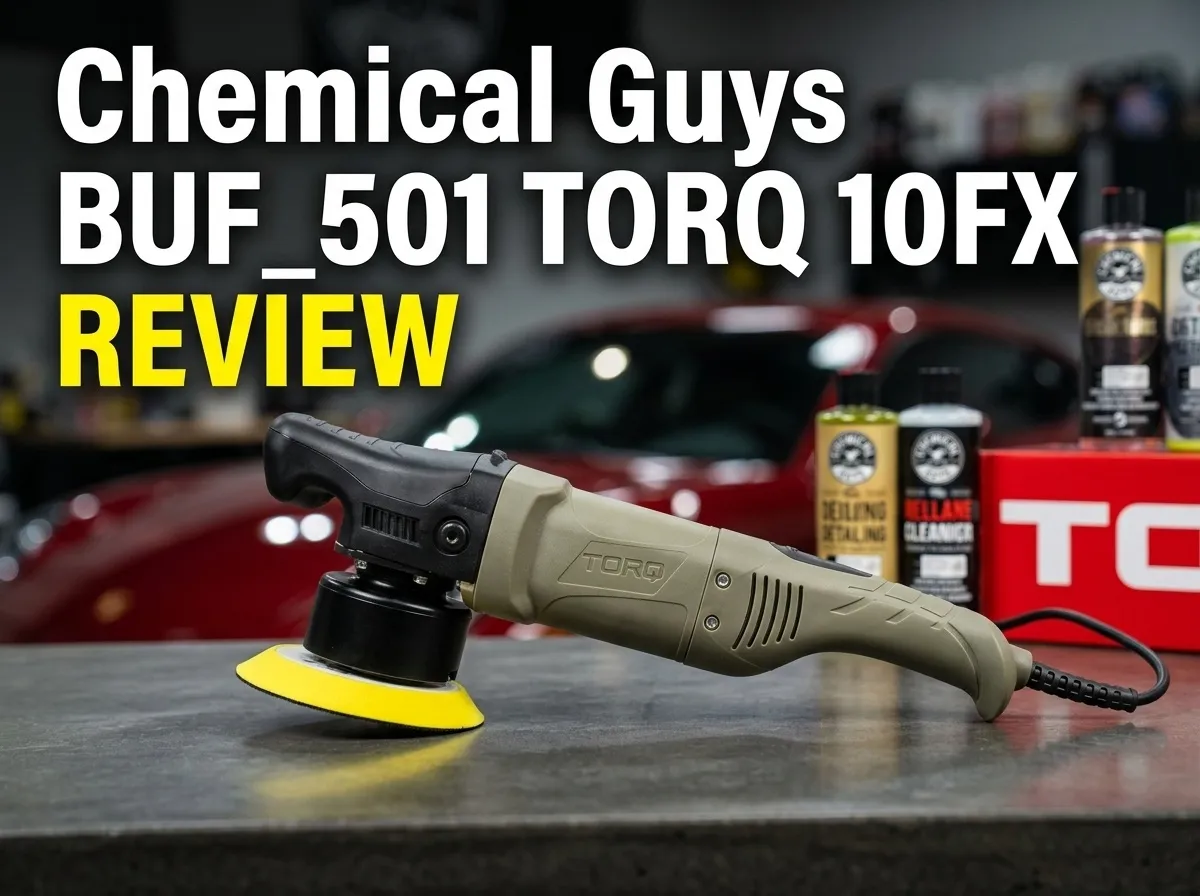
Chemical Guys TORQ 10FX Review: Honest Detailing Verdict
Updated May 2026
Staring at the heavily oxidized bonnet of an older family vehicle, littered with deep swirl marks from years of automatic car washes and a mishandled winter snow brush, is a deeply frustrating experience. Doing paint correction by hand with a microfiber towel and sheer elbow grease is an exercise in futility that ends in numb shoulders and disappointing results. Like many car enthusiasts, I wanted that deep, mirror-like showroom shine, but I was genuinely terrified of using a high-speed professional rotary buffer and accidentally burning straight through the clear coat or stripping the edges of the paintwork. That specific fear of damaging my own car is exactly why I decided to put the Chemical Guys TORQ 10FX random orbital polisher to a rigorous test.
Over the course of testing this machine on multiple vehicles, including a high-mileage daily driver with faded clear coat and an older sports car with soft, sensitive paint, I evaluated how this digital dual-action polisher handles prolonged detailing sessions. This review breaks down exactly how the tool performs in real garage conditions, where it excels, and the frustrating design quirks that the marketing materials completely gloss over.
Quick Verdict: Is the TORQ 10FX Worth Your Money?
Our Rating & One-Line Summary
Score: 8.4 / 10
The Chemical Guys TORQ 10FX is an exceptionally well-balanced, safe, and highly predictable dual-action polisher that effectively removes heavy oxidation and swirl marks, making it a stellar investment for passionate enthusiasts, though it is slightly held back by annoying digital button placement and a modest 8mm throw.
What We Loved
- Flawless Tool Balance: The physical weight distribution and updated rubberized grips minimize hand-numbing vibrations, allowing you to work for hours without intense muscle fatigue.
- Mistake-Proof Paint Safety: The random orbital dual-action movement naturally bogs down and stops spinning if you apply excessive downward pressure or hit a sharp body line, preventing any risk of burning the vehicle’s paint.
- Versatile Backing Plate Compatibility: The internal machine architecture allows you to easily switch between 3-inch, 4-inch, 5-inch, and 6-inch backing plates to tackle everything from massive flat SUV roofs to tiny, intricate bumper curves.
What Disappointed Us
- Frustrating Speed Button Placement: The digital adjustment buttons sit exactly where your thumb and hand naturally grip the neck of the tool, leading to frequent, accidental speed shifts mid-polish.
- Slower Correction Speeds: The safe 8mm orbital throw takes significantly longer to correct deep scratches compared to more aggressive 15mm or 21mm long-throw polishers on the market.
- Short Warranty Period: Chemical Guys only provides a limited 1-year warranty on this unit, which falls noticeably short of direct competitors in this exact price tier that offer lifetime protection.
Precision Paint Correction: The Core Performance
Eliminating Oxidation and Swirl Marks
The true test of any paint correction tool is how it handles years of environmental neglect, UV damage, and poor washing techniques that leave paint looking dull, cloudy, and grayed out. During my extended testing on a 15-year-old vehicle with 230,000 miles of road abuse, the paint surface was deeply oxidized and covered in fine angel-hair scratches. Moving a tool like this back and forth across a panel reveals exactly how efficiently the motor transfers energy to the clear coat.
Real-World Test: Restoring Faded Paint on a 230,000-Mile Daily Driver
I set up a test section on the hood, dividing it completely with painter’s tape to track the progress. I paired the TORQ 10FX with a heavy-cutting orange foam pad and a heavy compound. Dropping the machine down onto the horizontal surface, I spread the product evenly at speed setting 1, then ramped the machine up to speed 4 and 5 for the actual correction passes.
Working the tool across the panel using slow, steady arm movements, the 700-watt motor maintained a highly consistent speed without bogged-down hesitation. The machine does the heavy physical lifting for you. After four cross-hatch passes, wiping down the residue with a clean microfiber towel revealed a staggering transformation. The heavy oxidation, deep stains, and intersecting swirl marks were completely gone. The reflection was so sharp that you could clearly read the labels on the storage shelves across the garage and see the distinct shapes of clouds in the sky overhead. The paint on a high-mileage vehicle looked entirely rejuvenated, convincing onlookers that the car had been completely repainted.
Handling Intricate Body Lines and Contours
Modern vehicles are rarely made of flat, simple sheets of metal; they are covered in complex curves, sharp body lines, aerodynamic recessed channels, and tight plastic bumper valances. A bulky or unyielding polisher will quickly stall out or become impossible to control when it transitions from a flat door skin to a curved wheel arch.
The TORQ 10FX handles these transitions beautifully because of its versatile backing plate integration. While it comes stock with a 5-inch backing plate, I swapped it out for a flexible backing plate during portions of my testing to conform more naturally to the curved panels of a compact sports car. The machine transitions from flat surfaces to tight body lines smoothly. Because the random orbital motion naturally stops spinning if the edge catches an extreme angle, you can navigate around tight side mirrors and door handles without the terrifying fear of instantly stripping the paint down to the bare metal primer.
Ergonomics, Vibro-Isolation, and Daily Usability
Working Comfort During Extended Detailing Sessions
Detailing an entire car is not a quick 10-minute job. A full paint correction and multi-stage protection process can easily stretch into a multi-day project requiring 6 to 12 hours of operating a vibrating machine held directly out in front of your body. If a polisher is poorly balanced, your hands will become completely numb within 30 minutes, and your wrists will feel stiff and painful the next morning.
Real-World Test: A Two-Day Marathon Detailing an Eight-Year-Old SUV
To evaluate the long-term physical strain of this tool, I used it for a grueling two-day detailing marathon on a large, eight-year-old family SUV with massive vertical door panels and a towering roof. Weighing in at 5.5 pounds for the bare machine and roughly 7.6 pounds when fully outfitted with a heavy cord, backing plate, and wet foam pad, the unit initially feels quite substantial in the hand.
However, the internal weight distribution is engineered so perfectly that you do not need to fight against the tool. Even when working on vertical side panels where you cannot rely on gravity to hold the machine down, the balanced chassis means you do not have to exert heavy muscle force to keep it flat. The updated, rubberized ergonomic grips absorb the bulk of the internal mechanical vibrations. After working continuously for four hours on the first day, my hands were entirely free of that frustrating, itchy numbness that typically comes from cheap, entry-level hardware. If you are an older enthusiast with stiff joints, this smooth operational profile allows you to complete massive detailing projects in absolute comfort, provided you pace yourself and work a few hours at a time.
The Power Cord and Workplace Maneuverability
A detailing tool is only as good as your ability to move it around the perimeter of a vehicle without dragging components across freshly polished clear coat. The factory cord attached to the TORQ 10FX is reasonably heavy-duty and long enough to handle localized work, but it does have specific real-world limitations. To safely navigate all the way around a full-sized truck or long sedan from a standard garage wall outlet, you will absolutely need to pair this machine with a high-quality, heavy-gauge extension cord to prevent voltage drops and ensure you can reach every single corner without restriction.
Digital Control Accuracy vs. Real-World Quirks
The Onboard Digital Speed Display
The standout physical feature of the TORQ 10FX is its integrated digital speed adjustment system, which displays your current working settings on an intuitive LCD screen. Traditional dual-action polishers utilize a mechanical, clicking thumbwheel tucked away on the back or bottom of the housing, which requires you to guess your exact speed or memorize numbers that can wear off over time.
The digital display system maps the power output of the 700-watt motor across six distinct speed settings, giving you clear, visual confirmation of your operational range. Whether you are running at a low 1,500 OPM (Orbits Per Minute) to delicately spread a thin layer of liquid carnauba wax, or ramping all the way up to 4,200 OPM to tackle severe clear coat defects, the screen keeps your parameters clearly visible. This level of precision is comforting for users who want absolute control over their work environment.
The Critical Interface Flaw
While the digital display looks pristine and high-tech, the actual execution of the physical control interface introduces a prominent real-world nuance that can easily frustrate users during a long detailing job. The digital speed adjustment buttons are positioned directly on top of the narrow neck handle housing, precisely where the operator’s thumb and palms naturally rest to apply stabilizing pressure.
Because the buttons require only a light press to register, it is incredibly easy to accidentally bump the speed up or down while shifting your body position around a fender. You might be carefully working a delicate section at speed 3, only to accidentally punch it up to full power because your thumb shifted slightly as you leaned over the hood. It does not ruin the tool’s effectiveness, but it acts as a constant minor nuisance that forces you to constantly monitor your hand placement or continuously glance down at the LCD screen to ensure your settings haven’t shifted mid-pass.
What Real Buyers Are Saying: Review Analysis
The Most Common Praise
A comprehensive analysis of buyer feedback shows an overwhelming appreciation for how easily this tool saves neglected paint jobs without requiring professional training. Enthusiasts who were previously intimidated by machine polishing frequently note how “idiot-proof” the system feels. Owners of older sports cars, such as a 2004 Corvette Z06 or an aging Toyota Sequoia, consistently report that the tool successfully erased decades of deep oxidation, light scratches, and severe water staining when paired with high-quality compound kits. Buyers frequently celebrate the profound visual results, with multiple users exclaiming that their finished paint looked so highly reflective that you could clearly see distinct “cloud reflections” in the bodywork. The smooth, balanced operation also receives high marks, with users noting that it runs multiple steps above entry-level tools purchased from discount freight stores.
The Most Common Complaints
The most persistent criticism leveled against the TORQ 10FX centers squarely on the placement of the digital speed buttons, with multiple reviewers pointing out that it is far too easy to unintentionally alter the machine’s velocity while gripping the neck. Another recurring complaint comes from seasoned detailers or users who have operated long-throw machines; they note that the 8mm orbit does not spin fast enough at maximum power to cut through deeper defects quickly, requiring more passes and a longer time commitment to finish a vehicle. Additionally, international buyers living outside of North America express heavy frustration regarding voltage requirements, as the tool is built strictly for 110V/120V electrical grids and will immediately fail if plugged into a 220V outlet without an industrial transformer.
The Patterns We Noticed
When looking closely at the feedback trends, a clear pattern emerges based on user experience. Total beginners and older DIY enthusiasts who haven’t detailed a vehicle in decades absolutely love this machine because it eliminates the risk of burning through edges or leaving ugly holograms in the paintwork. It provides an immediate injection of confidence. Conversely, users who are looking for maximum speed or running a high-volume professional shop tend to find the 8mm throw slightly restrictive and find the 1-year factory warranty underwhelming compared to other mid-tier polishers that provide lifetime coverage.
Answering Your Biggest Questions About the TORQ 10FX
Can a beginner burn paint with the Chemical Guys TORQ 10FX?
It is practically impossible for a beginner to burn through a vehicle’s clear coat using this machine under normal operating conditions. Because the tool operates on a dual-action, random orbital mechanism, the pad does not just spin in a continuous circle like a traditional rotary buffer; it simultaneously oscillates in a small 8mm pattern. If you press down too hard against the paint, or if you wedge the edge of the pad into a sharp body crease, the pad will simply stop spinning entirely. This built-in mechanical safety stop prevents friction heat from building up to dangerous levels, making it entirely forgiving for an inexperienced user.
What throw does the TORQ 10FX have, and what does it mean for correction speed?
This polisher features an 8mm throw, which means the polishing pad moves off-center by exactly 8 millimeters as it oscillates. An 8mm throw is considered the standard benchmark for entry-level safety and precise, tight control. The direct real-world trade-off is correction speed. Because the pad covers a smaller total surface footprint during each oscillation compared to a long-throw 15mm or 21mm tool, it takes longer to level down the clear coat and remove deep defects. It will absolutely get the job done beautifully, but you must be prepared to invest more time and complete a few extra passes on heavily damaged paint.
Does the TORQ 10FX work with smaller 3-inch pads?
Yes, the tool is designed to work across a variety of detailing requirements by allowing you to swap out the backing plate. While it comes packed with a standard 5-inch backing plate, you can purchase separate 3-inch or 4-inch backing plates to mount smaller polishing pads. This flexibility is highly advantageous when you need to polish narrow window pillars, complex front grilles, or deeply curved bumper sections where a large 5-inch or 6-inch pad simply cannot maintain flat contact with the paint surface.
Is the TORQ 10FX a dual-action or a rotary polisher?
The TORQ 10FX is strictly a dual-action random orbital polisher. It combines a central spinning rotation with a secondary orbital oscillation. A rotary polisher, by contrast, forces the pad to spin continuously in a fixed circle at high speeds, which generates rapid heat and requires professional skill to avoid burning through the paint. The dual-action design of the TORQ unit ensures that heat is safely distributed across a wider area, prioritizing user safety and paint preservation above all else.
Why does my TORQ polisher seem to change speeds on its own?
If you notice the speed shifting up or down unexpectedly while you are polishing a panel, it is almost certainly due to your hand accidentally making contact with the digital adjustment buttons on the neck of the tool. Because of the highly sensitive button design and their placement directly on the primary ergonomic grip area, subtle shifts in your hand placement or palm pressure during a pass can trigger an unintended speed alteration. Adjusting your grip slightly further back or resting your lead hand entirely on the forward rubber hood will stop this from happening.
What the TORQ 10FX Gets Wrong: The Honest Truth
The Vulnerable Digital Button Interface
The single greatest operational flaw of the TORQ 10FX is the physical layout of its digital speed control interface. Putting digital buttons on a high-vibration tool right where an operator must grip it tightly to direct the machine shows a distinct lack of real-world testing. Detailers need to focus entirely on the pad’s interaction with the clear coat, tracking lines and watching compound breakdown. Having to constantly worry that a slight shift in your palm pressure will instantly drop your speed from a cutting level 5 down to a spreading level 2 is a persistent operational headache that could have been completely avoided by placing a physical lock switch or locating the buttons away from the primary handle neck.
The Disappointing 1-Year Warranty Overlook
When you spend hard-earned money on a premium detailing tool, you expect long-term manufacturer support. The TORQ 10FX lands in a price segment where several direct competitors offer robust lifetime warranties against internal mechanical failures. Chemical Guys, however, supplies this machine with a sparse, limited 1-year warranty window. For a casual hobbyist who might only detail their personal cars twice a year, a 1-year warranty means you may only use the tool three or four times before the factory coverage completely expires. This short protection window is an undeniable drawback for buyers looking for maximum long-term investment security.
Who Should Buy the TORQ 10FX — And Who Should Skip It
Perfect For These Buyers
- The Nervous Beginner: If you want to step up from manual hand-waxing but are deeply afraid of damaging your car’s clear coat, this tool provides a completely safe, forgiving entry point.
- The Weekend Car Enthusiast: Perfect for the garage hobbyist who wants to detail a couple of personal family vehicles or a classic weekend cruiser once or twice a year in absolute comfort.
- Hobbyists Valuing Ergonomics: If you suffer from joint stiffness or hand fatigue and want a machine that is beautifully balanced and smooth, this unit will let you work without physical misery.
Skip This If You…
- Are Running a High-Volume Detailing Shop: Professional mobile detailers who need to strip defects out of five cars a day will find the 8mm throw far too slow and time-consuming. You should look for a long-throw 15mm or 21mm machine instead.
- Live in a 220V–240V Country: If you are ordering from the UK, Europe, Australia, or the Middle East, this 110V tool is entirely incompatible with your electrical infrastructure and will require a massive, heavy external transformer to run.
- Want Simple, Tactile Analog Controls: If you prefer the unkillable nature of a physical, analog thumbwheel that can never change settings unless you deliberately click it, the sensitive digital buttons on this machine will likely drive you crazy.
TORQ 10FX vs. Competitors: How It Stacks Up
vs. Griot’s Garage G9
The Griot’s Garage G9 is widely considered one of the fiercest rivals to the TORQ 10FX in the enthusiast detailing market. When you place these two machines side-by-side, the raw specifications present a very compelling story for comparison.
The Key Difference That Matters
The Griot’s Garage G9 wins decisively on raw muscle and investment protection, boasting a potent 1000-watt motor compared to the TORQ’s 700-watt motor, and it comes backed by a legendary lifetime warranty. The Griot’s unit cuts through heavy defects noticeably faster because of that extra power reserve. However, where the TORQ 10FX strikes back is its digital speed precision and vastly superior horizontal balance. The G9 utilizes a traditional analog thumb dial and can sometimes feel a bit more unwieldy, whereas the TORQ 10FX provides an exact, bright digital read-out of your operational tier and runs with slightly smoother overall balance through the hands.
vs. Porter-Cable 7424XP
The Porter-Cable 7424XP is the undisputed legendary workhorse of the entry-level dual-action detailing universe. It has been used in garages for decades and is famous for its simple, rugged reliability.
The Key Difference That Matters
The Porter-Cable 7424XP is an absolute tank built with utilitarian, analog simplicity; there are no digital screens to glitch out, no sensitive buttons to accidentally bump, and its mechanical design is nearly indestructible. The major trade-off, however, is user comfort. The Porter-Cable transfers an intense amount of harsh, bone-rattling vibration directly into the operator’s hands and wrists, making long detailing sessions a physically exhausting chore. The TORQ 10FX is lightyears ahead in terms of modern industrial design, offering a beautifully balanced body, sophisticated internal vibration damping, and an ergonomic structure that makes the detailing process a genuinely enjoyable, smooth experience rather than a physical endurance test.
Price, Value & Is It Worth It?
Current Pricing & Distribution
The Chemical Guys TORQ 10FX occupies a firmly established mid-tier price point in the automotive detailing tool market. It is available as a standalone tool configuration for users who already own a comprehensive collection of pads and compounds, but it is most frequently purchased as part of a comprehensive 9-item kit. This factory bundle wraps the polisher together with specialized backing plates, a select variety of hex-logic foam cutting and finishing pads, and a full sequence of their proprietary paint correction compounds.
Value Compared to Alternatives
Evaluating this tool’s value depends entirely on how you choose to purchase it. If you purchase the TORQ 10FX as a standalone tool, the value proposition faces stiff competition from alternative options that offer substantially longer warranties and higher motor wattages for the same cash outlay. However, if you are a total beginner starting entirely from scratch, purchasing the full 9-item kit represents phenomenal value. The bundled foam pads and matching compound bottles are precisely calibrated to work in perfect harmony with the machine’s 8mm orbital mechanics. Buying those components individually would cost significantly more, making the bundled kit a highly economical, all-in-one path to professional-grade DIY results.
Final Verdict
The Chemical Guys TORQ 10FX successfully delivers on its core promise, serving as a highly effective, beautifully balanced, and incredibly safe paint correction tool that takes the terrifying guesswork out of machine polishing. It earns a solid 8.4 out of 10 for its excellent vibration management and beginner-friendly safety engineering, making it an ideal choice for the garage enthusiast looking to safely restore a flawless showroom shine to their personal vehicles. If you want a tool that makes the detailing process incredibly smooth and forgiving, this is a phenomenal addition to your garage arsenal.
If you are ready to eliminate ugly swirl marks, wipe away years of dull paint oxidation, and restore a genuine mirror reflection to your vehicle without the fear of damaging your clear coat, check out the options and current availability of this tool kit.
Frequently Asked Questions
What specific maintenance does the TORQ 10FX require to keep running smoothly?
To preserve the internal machinery, you should regularly blow out any accumulated compound dust from the motor vents using compressed air after every major detailing project. Additionally, periodically inspect the carbon brushes for wear and ensure the backing plate screw remains tightly secured to prevent dangerous operational wobbling during high-speed passes.
Can I use polishing compounds and pads from other brands with this machine?
Yes, you are completely free to use any third-party compounds or foam pads with this polisher. As long as the diameter of your polishing pads matches the size of the backing plate installed on the tool, you can seamlessly pair it with products from Meguiar’s, 3M, or Griot’s Garage.
Does the machine remember my speed setting if I turn it off to check my work?
No, the integrated digital interface resets its parameters whenever the master power switch is turned off. When you click the machine back on to resume polishing a panel, the digital system automatically defaults back to its lowest baseline setting, requiring you to manually click the buttons to ramp back up.
How much downward pressure should I apply to the machine while polishing?
You should apply very minimal downward pressure, typically just the natural weight of your hands resting on the grips. Let the mechanical oscillation of the machine and the cutting design of the chemical compound do the work. Pressing down too aggressively will simply stall out the safe dual-action rotation.
Is it necessary to use a pad conditioner before starting a paint correction pass?
Yes, using a light mist of pad conditioner on a fresh, completely dry foam pad is highly recommended. Conditioning lubricates the foam cells, ensuring the polishing compound spreads evenly across the face of the pad and reducing dry friction micro-marring when the pad first touches the clear coat.