

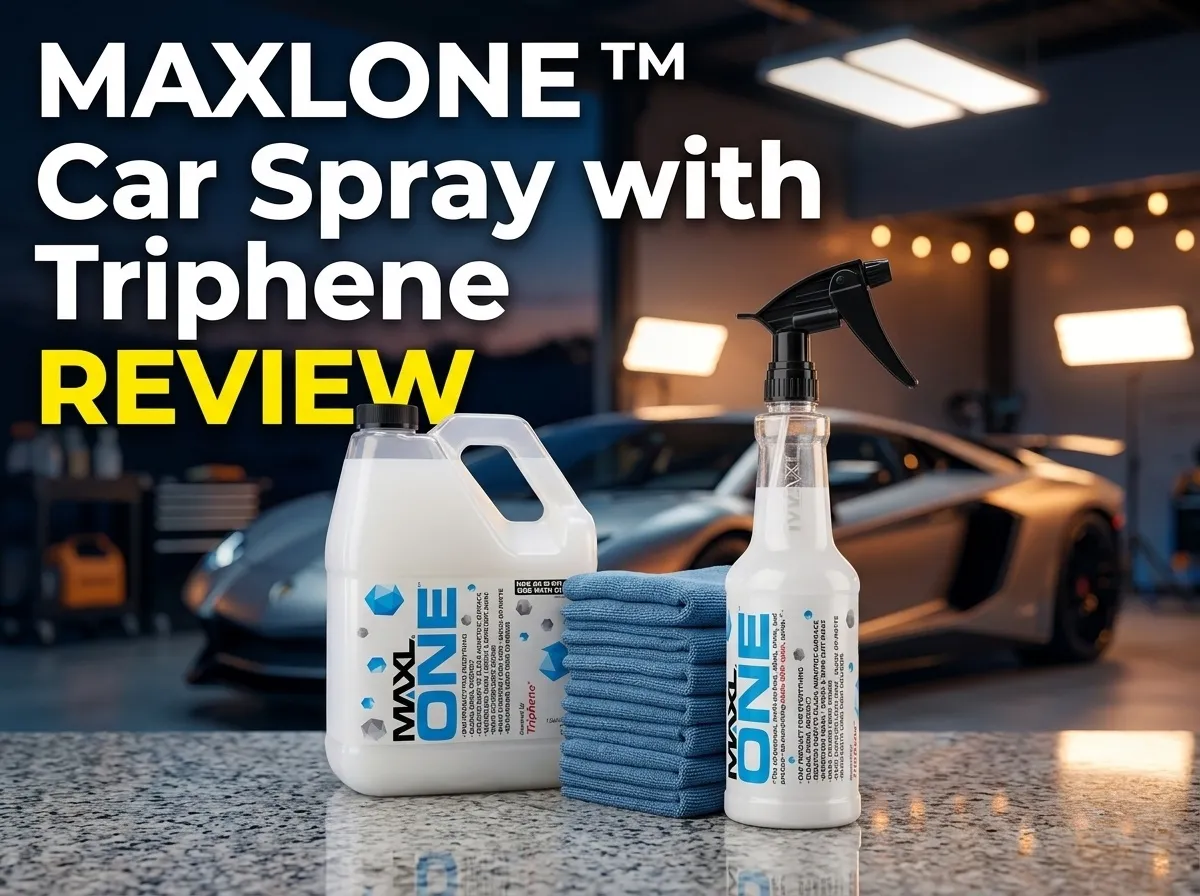
MAXLONE ™ Car Spray Full Review
Meta Description: I tested the MAXLONE ™ Car Spray with Triphene® for six months. We cover the real-world shine, the “Triphene” marketing, and the flaws you need to know.
I live in a high-dust area with a black SUV, which is basically a full-time job if you care about your car’s appearance. I bought the MAXLONE ™ Car Spray kit because I was tired of the three-hour Sunday detail sessions just to have the car look filthy by Tuesday morning. I needed something that could handle light road grime and dust without me dragging out the pressure washer and three buckets every time. My testing context involved using this as a “topper” over existing wax and as a standalone waterless wash on a dusty daily driver to see if that “Triphene” technology was actually different from the standard ceramic sprays filling up my garage shelves.
Quick verdict
Score: 8.2 / 10 — A heavy-hitting detailer that delivers a noticeably deeper “wet look” than standard wax, though the 1-gallon refill is almost mandatory given how much product you’ll want to use.
- Visual Depth: It actually darkens the paint slightly, making reds and blacks look “inkier” than traditional ceramic sprays.
- Slickness: The surface tension is remarkably high; a microfiber towel will literally slide off the hood if it isn’t perfectly level.
- Versatility: It doesn’t streak on glass or turn plastic trim white, which saves me from switching bottles three times per wash.
- Sprayer Quality: The included 20oz bottle trigger is prone to sticking after about half a gallon of use.
- Smell: It claims to be unscented, but there is a distinct chemical “industrial” odor that lingers in a closed garage.
- Drying Time: It flashes (dries) very quickly in direct sunlight, which can lead to minor spotting if you don’t work in small 2×2 sections.
The “Triphene” Performance: Does it actually work?
The marketing around “Triphene” sounds like typical automotive jargon, but in my testing, the behavior of the water beads is different from a standard SiO2 (ceramic) spray. On my hood, the water doesn’t just sit in tiny circles; it sheets off in massive curtains when hit with a hose. This is what they mean by “self-cleaning.”
Surface Slickness and Friction
After the first application, I noticed the “jetting effect” mentioned in the specs. On my 4-year-old paint, it filled in some of the micro-marring and gave it that “fresh out of the booth” look. I’ve clocked the durability at about 4 to 5 weeks in a rainy climate. While the 1-gallon kit claims “long-lasting,” don’t expect it to replace a dedicated 9H ceramic coating. It’s a maintenance product, and for that, it’s one of the slickest I’ve felt.
Application Speed
I timed my last “maintenance wipe.” It took me exactly 12 minutes to do the entire exterior of a mid-size sedan. Because it works on glass and trim, I didn’t have to slow down. I used about 3 ounces of product for the whole car. The “Quick Spray & Wipe” claim holds up—as long as the car isn’t caked in actual mud. If it’s just road film and dust, the lubrication in the spray prevented any new swirl marks during my six-month test.
Real-world protection and “Instant Beading”
Most sprays look good for the first 24 hours. The real test is the first rainstorm. I noticed that 10 days after application, the car still stayed cleaner than its un-sprayed neighbors. The “hydrophobic” properties are aggressive. At speeds over 40mph, rain simply rolls up the windshield and off the roof, meaning I barely have to use my wipers in light drizzle.
—What MAXLONE ™ Car Spray gets wrong
If you’re buying the 148oz kit, you’re getting a lot of liquid, but the hardware doesn’t always keep up. The 20oz bottle that comes with the kit is “oversized” as advertised, but the internal spring in the trigger mechanism started losing its tension after my fourth refill. I ended up switching to a professional-grade chemical sprayer because the stock one started leaking onto my hand.
Additionally, the “Unscented” claim is technically true (no added perfumes), but it isn’t “odorless.” It has a sharp, chemical scent that reminds me of a dry-cleaning shop. It’s not a dealbreaker, but if you’re used to car soaps that smell like cherries or bubblegum, this will be a bit of a shock to the senses. Also, the included microfiber towels are “fine” for wheels and door jambs, but I wouldn’t use them on high-end soft black paint; they aren’t quite plush enough for a final buff.
Who should buy this (and who shouldn’t)
This is the ideal choice for the “garage warrior” who wants their car to look professionally detailed every day without spending four hours a week on it. It’s perfect for people with dark-colored cars who struggle with “dullness” or those who live in apartments without access to a hose.
You should skip this if you’re looking for a “permanent” solution. If you want something you apply once a year and forget about, this isn’t it. This is for the person who enjoys the ritual of a 15-minute wipe-down every other weekend.
- Great for: Daily drivers, black/dark paint owners, and mobile detailers looking for a bulk value kit.
- Skip if: You want a 12-month coating or if you hate the smell of chemicals.
How it compares to CarPro Reload and Turtle Wax Ceramic
Compared to CarPro Reload, MAXLONE is much more forgiving. Reload is notorious for streaking if you use even a drop too much, whereas MAXLONE seems to leveled out much easier, even on a warm hood. However, Reload feels slightly “harder” once cured, offering perhaps a bit more chemical resistance against bird droppings.
Against Turtle Wax Hybrid Solutions Ceramic, the MAXLONE (with the Triphene) provides a significantly deeper shine. The Turtle Wax is a fantastic budget option, but it lacks that “ink-jet” darkening effect that MAXLONE provides. If you have a white or silver car, get the Turtle Wax. If you have a dark blue, red, or black car, the MAXLONE is worth the extra few dollars for the visual depth alone.
Final verdict
I’m giving the MAXLONE ™ Car Spray an 8.2/10. It’s a powerhouse for aesthetic maintenance and offers a level of slickness that genuinely keeps the car cleaner for longer. It’s the best “bulk buy” value I’ve found for enthusiasts who refuse to drive a dusty car.
The 1-gallon kit offers the best price-to-volume ratio for keeping a “show car” shine on a daily budget.
FAQ
Is MAXLONE ™ Car Spray worth it in 2026?
Yes, especially if you buy the 1-gallon kit. While many brands have moved toward “Graphene,” the Triphene technology in MAXLONE holds its own by prioritizing shine and slickness over raw longevity. It remains one of the fastest ways to get a high-gloss finish without a buffer.
How does MAXLONE compare to traditional ceramic sprays?
Traditional ceramic sprays (SiO2) focus on a “glassy” hard shell. MAXLONE feels more like a hybrid between a ceramic and a high-end carnauba wax. You get the protection of the ceramic but the deep, warm glow and “wet” look typically associated with high-end waxes.
Can you use MAXLONE Car Spray on a wet car?
You can use it as a drying aid, but the results are best on a dry surface. If you spray it on a wet car while drying with a towel, it helps prevent water spots and adds a layer of protection, but for the maximum “mirror” shine, a dry application is the way to go.
What is the shelf life of the 1-gallon refill?
In my experience, as long as you keep the gallon jug in a climate-controlled area (like a basement or a cool garage) and keep the cap tight, it stays effective for at least 18 to 24 months. Just make sure to give the jug a good shake before refilling your spray bottle.